How to get cited when the answer replaces the results.
A growing share of searches now end in a generated answer rather than a list of links, and the sources beside that answer are the new front page. Those sources are chosen by retrieval, which draws on pages the search system already trusts, then summarisation, which lifts passages it can quote cleanly. Which means the work is mostly search fundamentals, plus writing that survives being quoted.
Start with how the selection actually works, then the practices that influence it. Everything we publish on AI search lives below.

- Step 01
Understand the selection
AI Overviews are built from pages already ranking, but citation does not follow position one for one. Knowing what is influenced and what is not saves wasted effort.
Read the guide - Step 02
Separate real work from noise
Roughly eighty per cent of generative engine optimization is SEO fundamentals. The genuinely new part is narrow, cheap, and mostly editing.
Read the guide - Step 03
Apply it locally
For a business with a service area, proximity and profile data change the calculation of which sources an answer names.
Read the guide
The citation list rarely matches the rankings.
We ran the query "what is generative engine optimization" and recorded which sources Google's AI Overview actually drew from. Three of the six were YouTube videos, alongside a course platform, a software vendor and an SEO tool. The specialist publications you would expect to own that phrase were absent entirely.
That is the argument for checking your own priority queries rather than reasoning about who ought to be cited. Format matters more than most commentary allows, and the source list is its own competitive brief.
- 1coursera.org
- 2en.wikipedia.org
- 3youtube.com
- 4semrush.com
- 5seobility.net
- 6workshopdigital.com
Recorded from a live AI Overview, Aug 2026. Domains only.
Everything on AI search
Every guide we have published on being visible when an assistant answers instead of a results page.

How to Get Your Business Recommended by AI Search
Nearly half of people now ask an AI assistant which company to hire. AI search optimization is the work of ending up inside that answer: how it is built, what moves it, and what does not.
WebMCP: What Happened When We Made Our Own Website Work With AI Agents
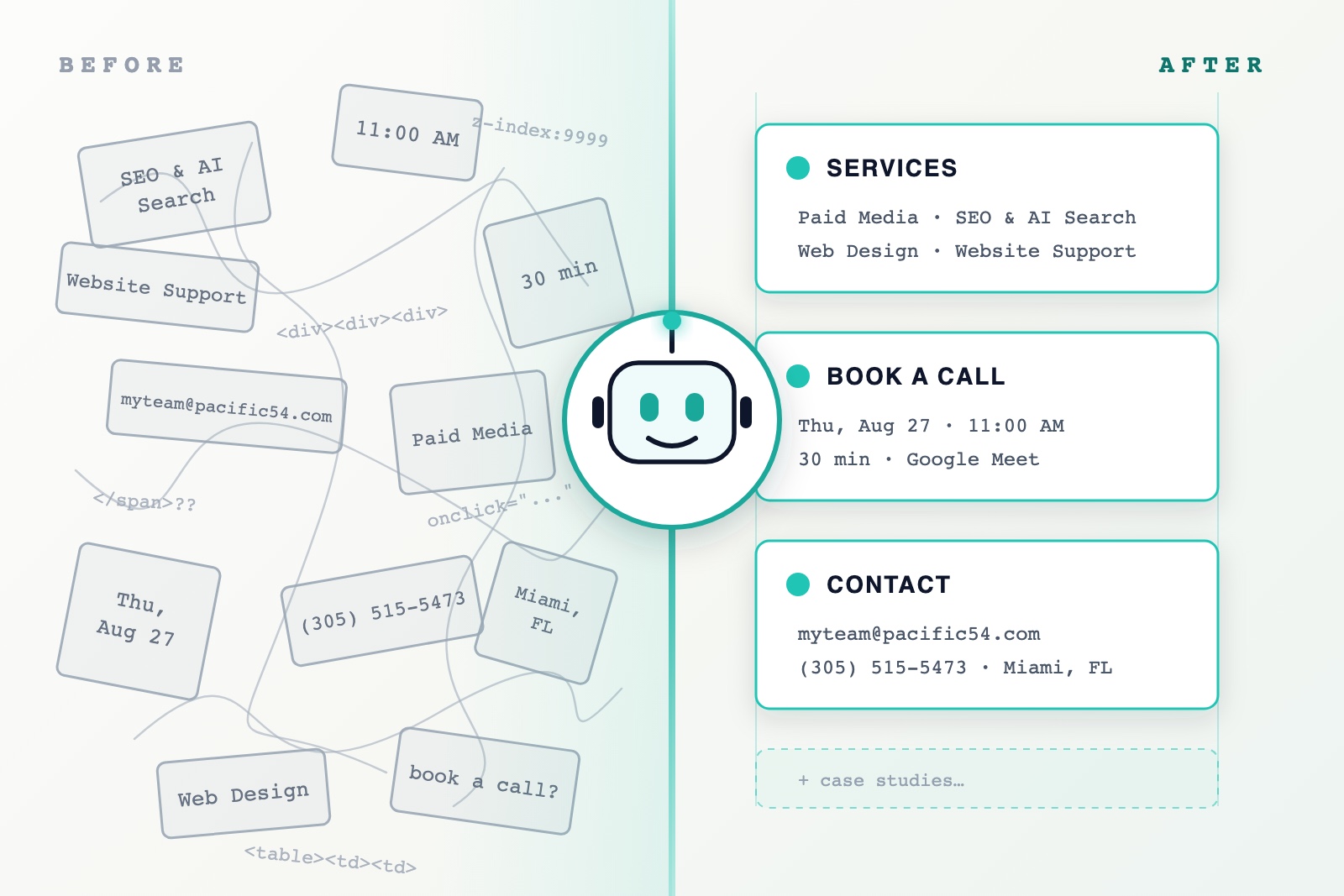
What WebMCP is, what it took to make pacific54.com bookable by AI agents, and what we learned that the documentation doesn't tell you.

ChatGPT SEO: How to Be Cited When People Ask ChatGPT
How ChatGPT finds and cites web pages, which crawler controls what, and the practical steps that make a business more likely to appear in its answers.

Generative Engine Optimization: What It Is and What It Isn't
What generative engine optimization actually means, how much of it is genuinely new, and what influences whether AI answers cite your business.

AI Overviews: How Google Chooses the Sources It Cites
What AI Overviews are, how Google selects the pages it cites inside them, and what a site can actually influence — separated from what it cannot.

LLM SEO: How Language Models Actually Learn About Your Business
The two ways a language model can know about your business, why only one of them is influenceable, and what that means for how you publish.

How AI Overviews Choose Local Businesses
What actually determines whether an AI Overview cites a local business, which signals you can control, and honest ways to measure the impact.
Frequently asked questions
Is AI search replacing SEO?
It is changing what visibility means rather than removing the work behind it. Generative answers are built by retrieving content the search system already considers relevant and trustworthy, so ranking well remains the entry requirement. What shifts is the unit of value: search ranks pages, generative systems quote passages, which rewards clear structure and direct answers more than it used to.
Can you optimise specifically for AI Overviews?
Not as a separate technique. Google states there is nothing special to do for AI features and that standard search practices apply. The things that genuinely help are ordinary search fundamentals plus a structural editing habit: state answers plainly under headings phrased the way people ask, and cover the adjacent questions as well as the headline one.
How do we measure whether AI systems cite us?
Manually, on a schedule, because no analytics product reports it reliably. Search Console folds AI Overview impressions into overall Search performance with no filter to isolate them. The workable method is a fixed list of questions a prospect would ask, run monthly across the assistants your audience uses, recording whether you are named, cited or absent, and who appears instead.