Meet demand at its peak
When a storm hits, the campaigns have to absorb the surge without losing efficiency.

Public adjusting · Lead generation
For Stellar Adjusting, Pacific54 ran the paid advertising that turned storm-driven demand into a steady monthly flow of claim inquiries.
Your firm next
Same team, same process, your clients.
Start the workThe challenge
Public adjusting demand moves with the weather. A hurricane compresses a year of need into weeks; the months between reward firms that keep showing up for everyday water, roof, and mold claims. Clicks are expensive, and the people behind them are stressed and comparing options fast.
Stellar Adjusting needed more than traffic. It needed a system that could hold a steady cost per inquiry at high volume, surge when storms created urgency, and measure calls as carefully as forms, because in this business, the phone is the pipeline.
When a storm hits, the campaigns have to absorb the surge without losing efficiency.
Claim inquiries arrive as calls as much as forms. Every call needed a source, so budget could follow quality.
When the model held in Florida, the same system had to travel to new metros without starting from zero.
The acquisition system
Search campaigns met the demand, dedicated pages carried the message, and call tracking connected every inquiry back to the decision that created it.
Storms and everyday claims send property owners searching for help
Campaign landing pages match the claim type behind each search
Every inquiry is captured and attributed, on the phone or on the page
Reports turn results into budget moves the next month acts on
How the system worked
Three capabilities carried the engagement: a demand engine that held its economics, a storm response that moved in days, and call tracking that kept quality honest.
Demand engine
Google Ads concentrated spend on high-value neighborhoods and specific claim types, each landing on a page built for that claim. The system absorbed hurricane-season surges without losing its footing, and when the model expanded to a new metro, it converted from its first month.
Volume did not come at the price of efficiency; the campaigns held their economics at peak demand.Storm response
When Hurricane Milton hit, response campaigns went live on Meta and LinkedIn within days: residential and commercial tracks, each speaking to the damage owners were facing that week, while the core search engine kept running.
Speed to market is the difference between serving a storm’s victims and missing them.Roof, water, and flood damage claims for homeowners
Business-property claims reached through LinkedIn
Call tracking
Call tracking gave every inquiry a source: Google Ads, the website, or an ad extension. That closed the loop between spend and the phone. When a call-only campaign brought volume without substance, the data showed it and the budget moved.
Measured calls meant decisions followed inquiry quality, not click counts.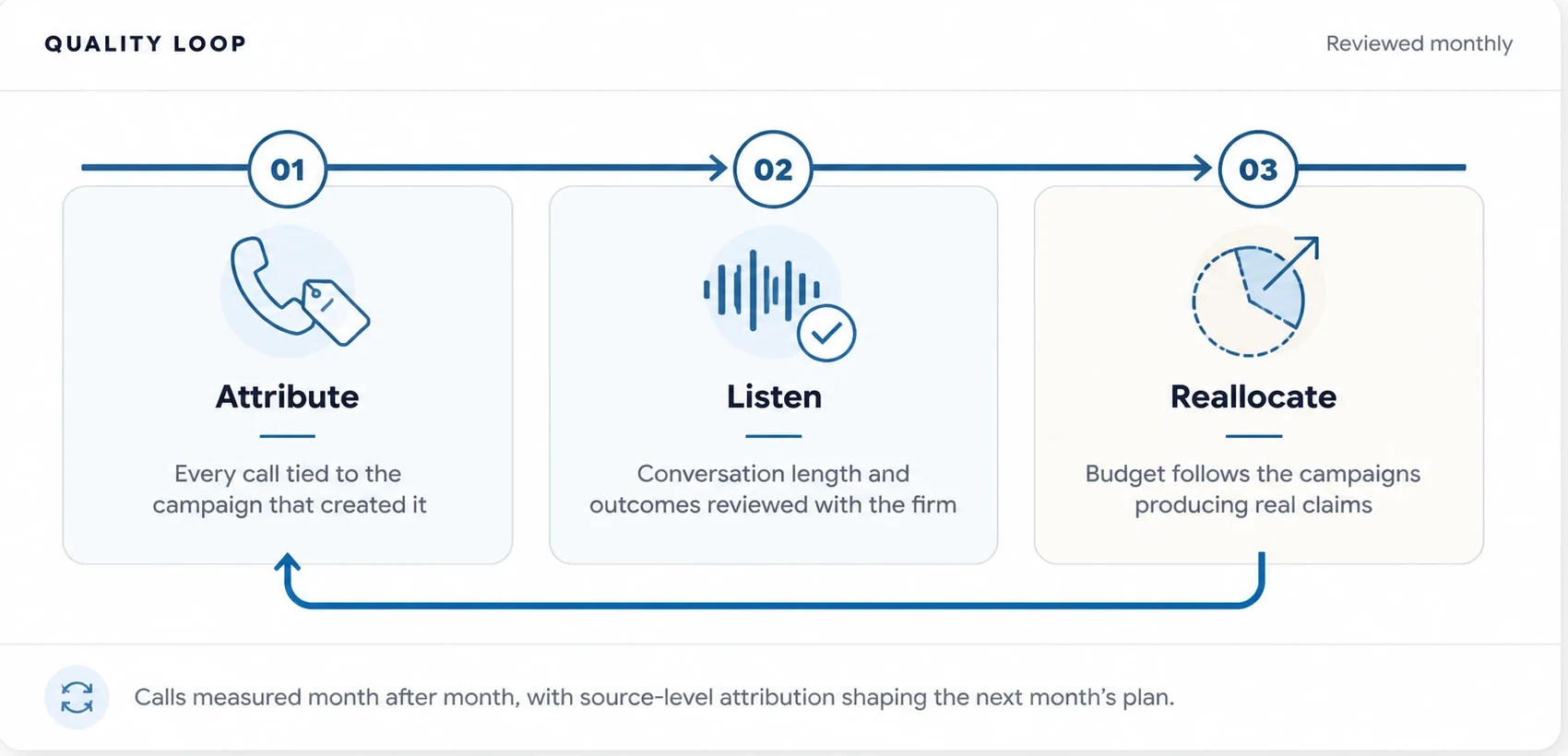
The outcome
A year of steady optimization cut the average cost per claim inquiry in half.
The first city Stellar expanded into produced affordable inquiries in its first month.
Source-level attribution let the budget follow the conversations that became real claims.
The takeaway
Storms decide when the phone rings. A measured acquisition system decides whether a firm is ready when it does. Stellar Adjusting’s campaigns, pages, and call tracking made demand something the firm could build on.
Talk about qualified growth