

Someone with a legal problem used to start with a friend, a search, or a billboard on the Palmetto. Now a growing share of them start by asking an assistant which firm to call, and that assistant builds its answer from directories, review profiles, and comparison articles rather than from your website.
For law firm marketing in Miami, that is a meaningful shift. This is a market with a lot of firms, a lot of advertising, and clients who compare hard before they call.
Where the search begins now
Forty-five percent of US consumers now use AI to find local businesses, up from six percent a year ago. Legal is not exempt. Ask any assistant for the best personal injury or immigration firm in Miami and you will get a list of names, assembled from sources you can identify and, mostly, influence. The full mechanism is in how to get your business recommended by AI search.
What has changed is not that people research before they call. They always did. What changed is that the research now happens in one step, and something else performs it on their behalf. The prospective client sees a shortlist of three to ten firms and never sees the forty you were competing with.
What gets read before your site
In order of how often they are cited, these are the sources an assistant reads before it names a Miami firm. Each one has a name you already know.
- Legal and business directories
Avvo, Justia, FindLaw, Martindale-Hubbell, Super Lawyers, and your Florida Bar member profile. Read first, and the smaller sites copy their details from these.
- Review platforms
Google Business Profile above all, then Avvo client reviews and Yelp. Recency and replies are read, not just the star average.
- Community discussion
Reddit threads on r/Miami and r/legaladvice, Nextdoor, neighborhood Facebook groups. Someone asked your prospective client’s exact question a human way.
- Comparison articles
The "best personal injury lawyers in Miami" lists, from Expertise.com to a rival firm’s own blog. Disproportionately quoted.
- Press and local coverage
The Miami Herald, Daily Business Review, a case that made the news. Named and dated, so assistants keep it.
- The firm’s own website
Last. Consulted to confirm what the assistant already found, which is why it needs to be consistent and quotable.
That last position surprises people who have just spent heavily on a redesign. A new site is still worth building, but it is the thing that confirms a shortlist rather than the thing that creates one.
Your firm’s website is the last thing an assistant checks and the first thing most firms spend on. That order is worth revisiting.
This is not an argument against a good website. It is an argument about sequence. If your listings are inconsistent and your reviews stopped in 2023, a redesign improves the experience of the few people who already found you, and changes nothing about how many people find you at all.
The unglamorous work of law firm marketing in Miami
Step 1: Consistent details everywhere
The same firm name, address, suite number, and phone across every listing. Not close variations. Assistants and search engines both treat conflicting details as a reason for uncertainty, and uncertainty is how you get left off a list.
Step 2: A profile that looks alive
A Google Business Profile with recent photos, correct hours, accurate practice-area categories, and posts from this month rather than a 2019 photo set. Our profile ranking guide walks the fields in order.
Step 3: Reviews as a habit, not a campaign
A steady flow beats a burst. Fifteen reviews in one week after a push reads exactly like what it is. Two or three a month, every month, reads as a practice that people keep using. Reply to all of them, including the difficult ones.
Step 4: Directory profiles that actually say something
Most firms claim a directory listing and leave the description blank. The description is the part that gets quoted. Write it once, properly, and paste the same version everywhere.
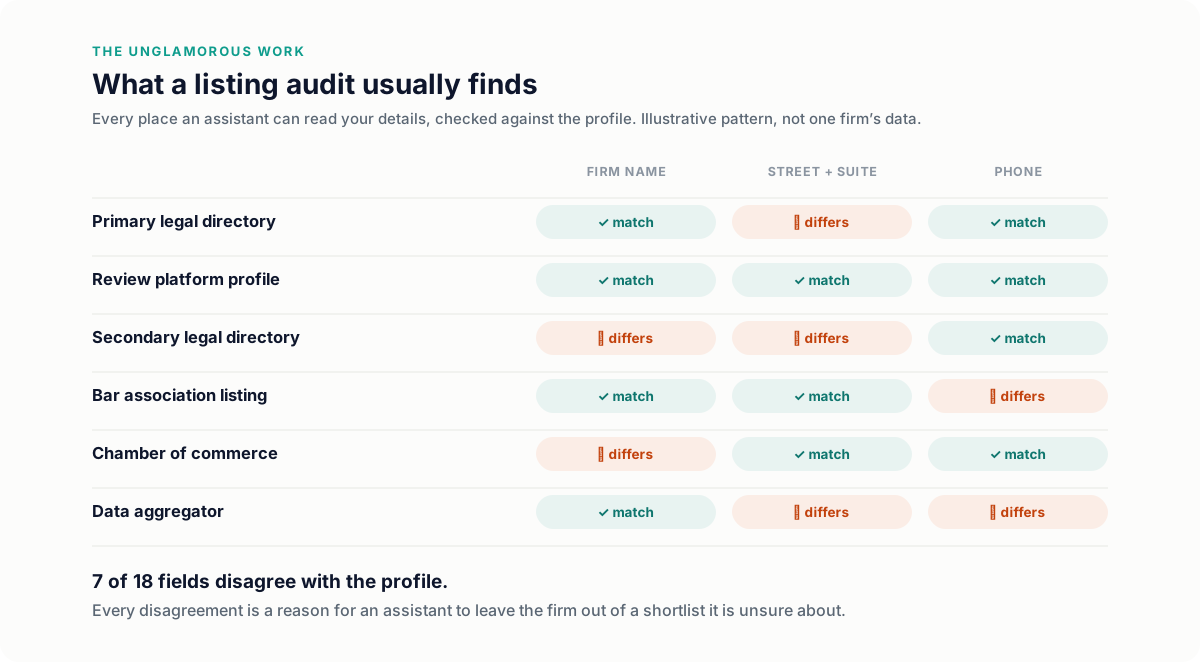
Step two leans on the profile ranking guide, and the reply habit in step three on how to respond to a bad review.
None of it is exciting and all of it feeds the answers.
Practice-area pages that hold up
Google’s spam policies single out scaled content abuse, and enforcement against thin, templated pages keeps sharpening. Legal marketing has produced a great deal of both. A practice-area page built from a template with the city swapped is exactly the shape that gets caught.
The fix is not volume, it is substance. A page that earns its place answers the questions a worried person actually types at midnight: what the process looks like step by step, what it is likely to cost, how long it usually takes, what happens if the case does not settle, and what your firm specifically has handled in that area.
One page written that way outperforms twenty built from a template, and it is the only kind of page an assistant can quote from.
Measuring it
Track the questions, not just the rankings.
Write down the five questions a prospective client would ask an assistant. Check monthly which firms get named, and record which sources each answer was built from. Watch whether your firm enters the list, and which source got you there.
Your answer check
Are you named?
Edit the questions to match your business, ask each assistant, tap a cell to record the result. Stays in this browser.
| Question | ChatGPT | Perplexity | Google AI Mode |
|---|---|---|---|
That second column, the sources, is the useful one. It is a work queue, and it is a harder metric to fake than a visibility score. It also maps to how clients actually arrive, which is the only test that matters.
For the wider picture beyond legal, see local search marketing and our law firm marketing playbook.