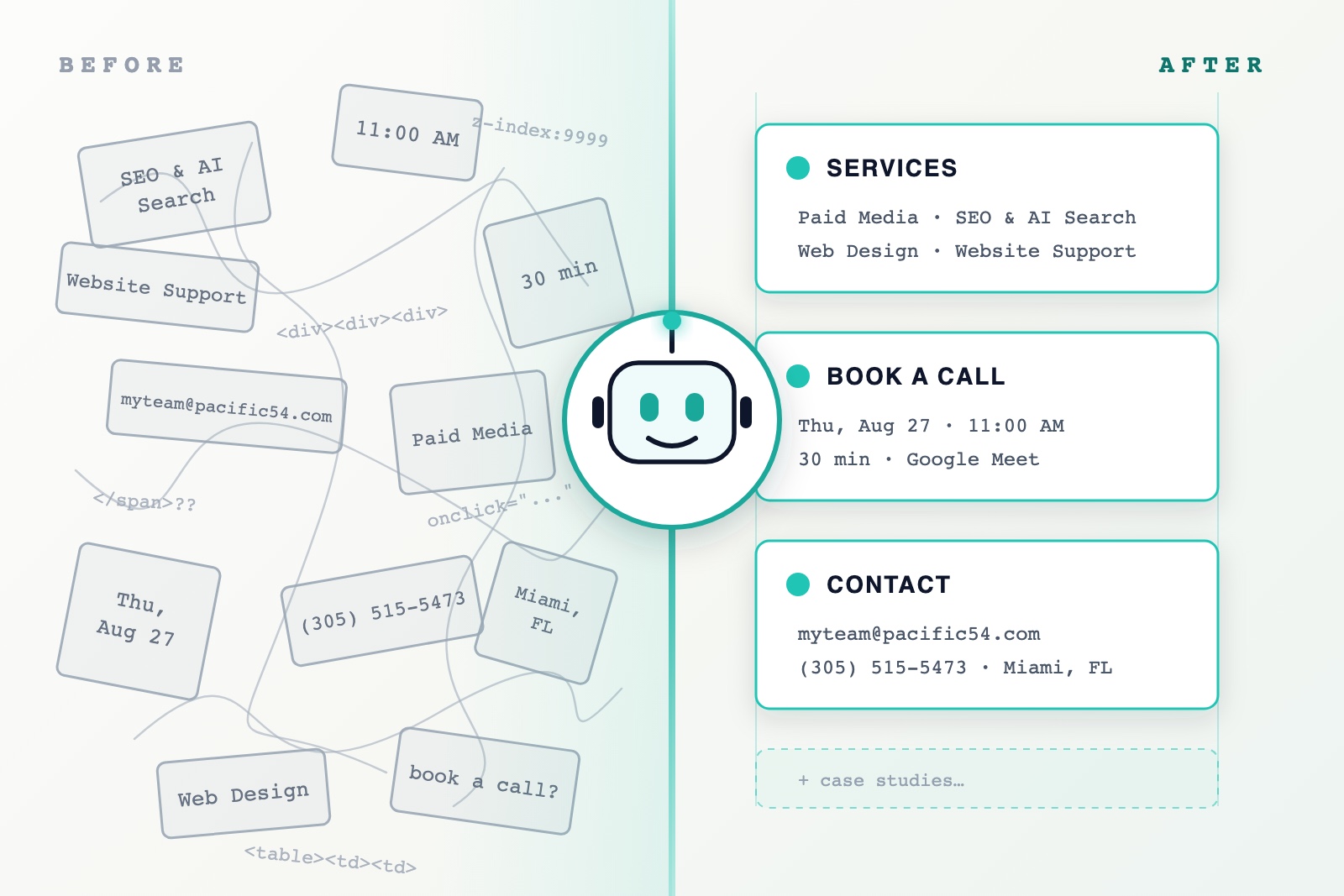

Ask ChatGPT, Perplexity, or Google’s AI for the best marketing agency in your city and you will get a confident list of ten names. Someone wrote the sources behind that list. Usually it was one of the agencies on it.
That is the whole game now, and it is what AI search optimization actually means: not ranking inside the answer, but shaping the sources the answer is built from. In a March 2026 survey of 1,002 US adults by BrightLocal, forty-five percent said they had used an AI tool to find a local business in the past year. A year earlier the figure was six percent. That makes AI the third most-used source for local recommendations, behind only Google and Facebook. Being invisible in those answers is the new version of being on page two.
We traced a live answer back to its sources
To see how these recommendations are actually assembled, we ran one in our own market: we asked an AI assistant which agency to hire for SEO in Miami, then followed the answer back to every source behind it.
Ten firms were named. The entire basis for that list was three “best agencies” comparison articles and one directory. Not a single one of the named firms’ own websites appeared in the sourcing. And two of the three comparison articles had been written by agencies that had placed themselves on them.
That is not a trick and it is not a loophole. It is the supply chain, and it is the same shape in every market we have traced. We broke down the mechanism separately in how AI Overviews choose their sources. Once you can see it, the work becomes obvious.
Where AI answers actually come from
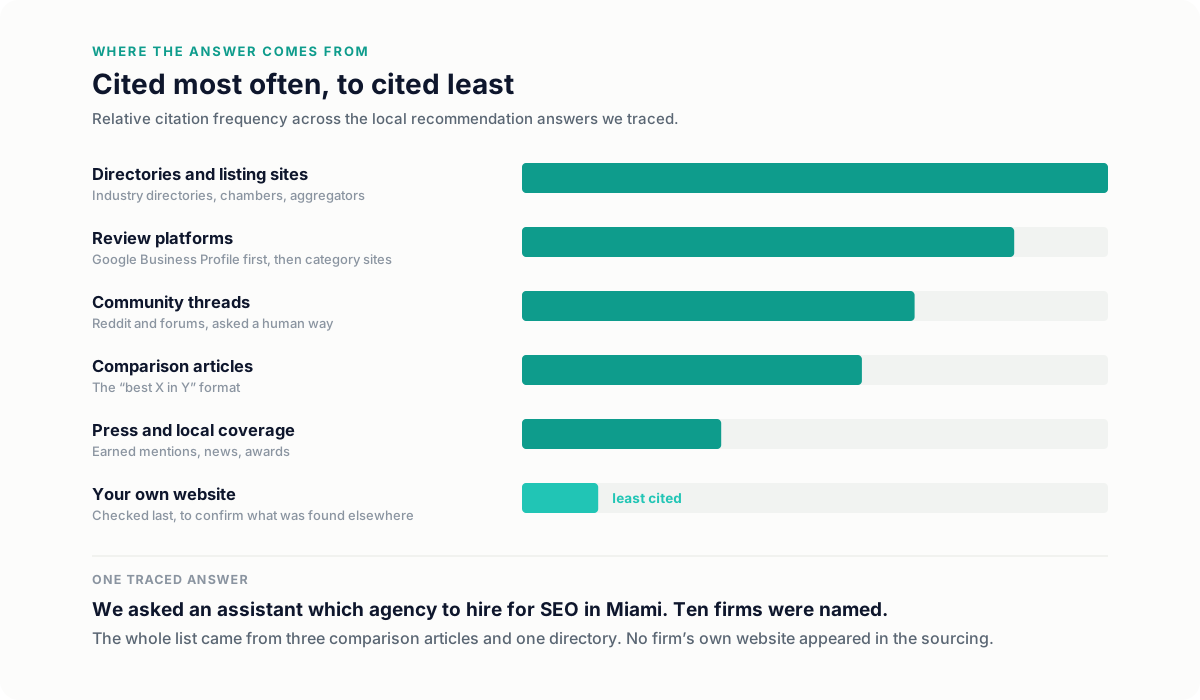
Across the local-business answers we have traced, the sources appear in a consistent order of frequency. Each one is also a place you can act.
- Directories and listing sites
Industry directories, chambers, and the big aggregators. Read first and most often, and the smaller sites copy from them.
- Review platforms
Google Business Profile first, then the category-specific ones. Recency and replies are read, not just the star average.
- Community threads
Reddit and forums, where someone asked the same question a human way. Nearly half of Perplexity’s top citations come from here.
- Comparison articles and listicles
The "best X in Y" format, disproportionately represented. Often written by a company that put itself on the list.
- Press and local coverage
Named, dated, attributable. Assistants keep claims that have an identifiable origin and drop the rest.
- The business’s own website
Last, and least often. Consulted to confirm what the assistant already found, which is why it needs to be quotable.
Your own website is the least-cited source in the entire chain. Its job is to be quotable when the machine checks your claims.
Most businesses spend in exactly the reverse order of this list. They fund the website, then the ads, and leave the directory profiles half-finished from 2019. If you change one thing after reading this, change the order you spend in.
Every assistant reads a different internet
The order above holds, but the weights do not. An analysis of 680 million AI citations published by Averi in March 2026 found that only 11 percent of domains cited by ChatGPT are also cited by Perplexity. Check one assistant and you are looking at roughly a tenth of the picture.
The differences are not subtle. SOCi’s 2026 Local Visibility Index found Reddit in 46.7 percent of Perplexity’s top citations and Wikipedia in 47.9 percent of ChatGPT’s. Google’s AI Overviews and AI Mode are built on Google’s own index, so there the ordinary signals still apply directly: how you rank, and what your Google Business Profile says. For Google’s assistant, the old work is the new work.
What AI search optimization consists of
Quotable statistics. Assistants lift passages that stand on their own. A sentence carrying a specific number, a date, and a source is far more liftable than a paragraph of positioning language. If you have proprietary data, publishing it is the single highest-leverage thing you can do.
Named sources. Claims attached to an identifiable origin survive the trip into an answer. Unattributed claims tend to get dropped, because the system has no way to stand behind them.
Clear structure. Headings that match the question being asked, answers placed directly under them, and no throat-clearing before the substance. This is not a new skill. It is the old skill, applied with more discipline, and it is most of what generative engine optimization actually consists of.
Consistency across sources. If three directories describe you three different ways, an assistant has no confident description to give. Being described the same way everywhere is unglamorous and it matters more than almost anything on your own site.
What does not work
llms.txt. SE Ranking’s study across roughly 300,000 domains found no relationship between having the file and being cited. Removing it from their model actually improved prediction accuracy, meaning it was adding noise rather than signal. Google has said it does not use the format.
Bought links. They did not work for search, and they do not work here. The sources that feed AI answers are read for what they say about you, not for the link.
Keyword-stuffed service pages. Density was already a dead signal. In a system that lifts passages, a page written for a crawler reads as a page with nothing quotable in it.
Make sure the machines can read you at all
This one is technical and it is the check most often skipped. When an assistant goes to confirm a claim, it sends a crawler: GPTBot and ChatGPT-User for OpenAI, PerplexityBot, ClaudeBot, Google-Extended. Every one of them runs from data-center IP ranges, and none of them can solve a JavaScript challenge.
Many hosts and CDNs now challenge data-center ranges by default as anti-bot protection. From a normal browser the site loads fine. From the crawler, every page returns a challenge screen, including the pages you wrote specifically for AI. We found exactly this on a client site in September: a file written for assistants, verified live, and served a robot check to the very audience it was meant for.
A seven-step AI search optimization checklist you can run this month
Step 1: Ask the questions yourself
30 minWrite down the five questions a buyer in your category would actually ask an assistant. Run each one in ChatGPT and Google’s AI, plus Perplexity if your buyers are technical. Record who gets named.
Step 2: Trace one answer to its sources
1 hourPick the answer that matters most and find every source behind it. The prompt at the end of this article does most of the work. It will reorder your priorities.
Step 3: Fix your listings
1 weekSame name, address, phone, and category description everywhere. Fix the aggregators first, because the smaller directories copy from them.
Step 4: Bring your Google Business Profile current
1 afternoonRecent photos, correct hours, accurate categories, and posts that are not a year old. Our Google Business Profile guide covers the fields that matter most.
Step 5: Start a steady review habit
ongoingA consistent trickle beats an annual push, because recency is visible and a burst reads as a campaign. Reply to every one.
Step 6: Get into the comparison articles
1 quarterFind the "best X in your city" lists that already rank. Some accept submissions, some are worth pitching, and some you will have to answer by writing a better one yourself.
Step 7: Make three pages quotable
1 weekTake your three most commercially important pages and put a specific, sourced, standalone claim near the top of each. One number, one date, one source.
Step four leans on our Google Business Profile guide. For what each assistant does differently once you are inside an answer, see ChatGPT SEO and LLM SEO.
How to measure whether it worked
There are three layers, and only one of them is precise.
What you can measure exactly: visits and leads from assistants. Every assistant that sends someone to your site leaves a referrer. In Google Analytics, filter sessions by source matching chatgpt.com|perplexity.ai|copilot.microsoft.com|gemini.google.com|claude.ai and look at the conversion rate next to organic search. On the client sites we track, that traffic is small and converts at several times the organic rate, which is the number that justifies the work.
What you can estimate: citation share. Tools such as Semrush’s AI toolkit, Ahrefs Brand Radar and Profound now report how often you are named. They sample answers that change with every run, so treat the number as a trend line, not a truth. Anyone showing you a precise AI visibility percentage is showing you an estimate wearing a lab coat.
What you should do regardless: the monthly check. Same five questions, same assistants, same day each month, recorded. Track two things: whether you are named, and which sources the answer was built from. The second column is your work queue for the following month.
Your answer check
Are you named?
Edit the questions to match your business, ask each assistant, tap a cell to record the result. Stays in this browser.
| Question | ChatGPT | Perplexity | Google AI Mode |
|---|---|---|---|
It is unglamorous, it takes twenty minutes, and it is the only measurement in this field that will not embarrass you later.