

Most manufacturer websites were built years ago, migrated at least once, and maintained by whoever had time. The result is a site that looks fine to a visitor and reads like a junkyard to a crawler. Before we touch keywords, content, or links, we run the same nine-point technical SEO audit on every manufacturing engagement. It is how a Miami engine-computer specialist we work with doubled its visits from Google search in under a year, the fixes came first, then the growth. This is that audit.
Why manufacturer sites leak organic equity
Industrial companies have a structural advantage in search that most of them never cash in. They have decades of domain history, real expertise that buyers search for, and product catalogs full of long-tail queries with purchase intent. What they usually lack is a site that lets Google see any of it.
The pattern repeats across almost every manufacturer we audit:
- A replatform (or two) left behind redirect chains and orphaned URLs that still collect clicks and waste crawl budget.
- The product catalog generates thousands of near-duplicate pages, one per size or finish, that compete with each other instead of ranking together.
- Spec sheets live in PDFs that hold most of the site’s real expertise and none of its crawlable structure.
- Templates were designed for desktop trade-show traffic and fail Core Web Vitals on the mobile devices procurement teams actually use.
None of this shows up in a marketing report. All of it shows up in rankings. It is also why a catalog is a programmatic SEO problem before it is a content problem.
You cannot rank a house that is falling over. Fix the structure first, then argue about paint colors.
The nine points, in the order we run them
The order matters. Each check either clears the ground for the next one or tells us the next one is not worth running yet.
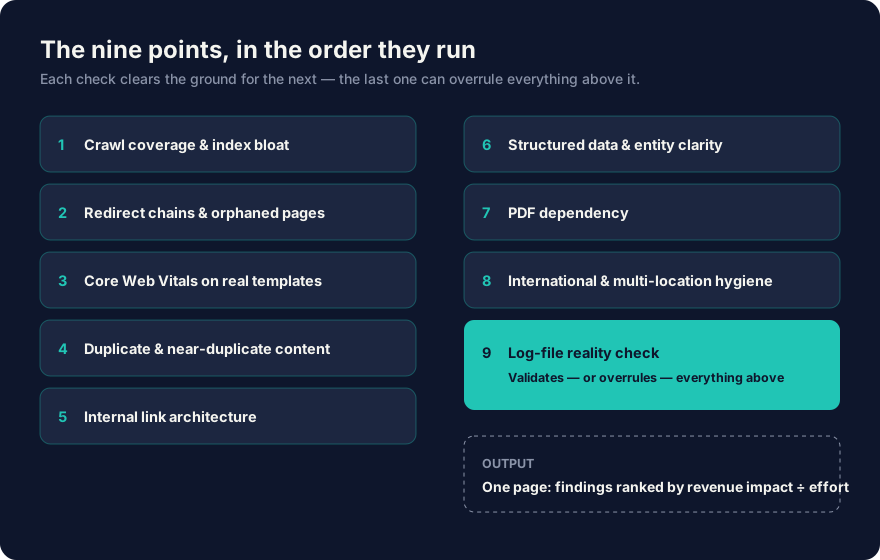
1. Crawl coverage and index bloat
We crawl the full site and compare it against what Google has actually indexed. The gap tells the story: pages Google cannot reach, and junk it reached that it never should have. Faceted URLs, session parameters, and staging leftovers regularly multiply a 500-page site into 50,000 indexed URLs, the classic crawl-budget leak.
2. Redirect chains and orphaned pages
Every replatform leaves scar tissue. We map redirect chains three or more hops deep, find pages that still earn links but redirect to the homepage, and locate orphaned pages that no internal link points to. Link equity that took a decade to earn is often sitting in a chain nobody has looked at since the migration, which is why the link profile deserves monitoring of its own.
3. Core Web Vitals on real templates
We test the templates that matter commercially: product family pages, spec pages, and location pages, on throttled mobile connections. Lab scores are a starting point. Field data from real Chrome users decides whether the template passes or gets rebuilt.
4. Duplicate and near-duplicate content
Catalog-driven sites generate variants faster than anyone can canonicalize them. We cluster near-duplicates, decide which page in each cluster deserves to rank, and consolidate the rest with canonicals or merges. One strong page beats twelve weak siblings every time.
5. Internal link architecture
We graph the internal link structure and measure click depth from the homepage to every revenue page. If a money page takes five clicks to reach, Google treats it the way users do: as an afterthought. The fix is usually structural, hub pages and contextual links, not a plugin.
6. Structured data and entity clarity
Product, Organization, and FAQ markup, applied where it is honest. This is also where we make the company legible as an entity: consistent naming, address data, and the connective tissue that lets Google, and increasingly AI assistants, understand who the company is and what it makes.
7. PDF dependency
We inventory every PDF that holds unique content: spec sheets, tolerance tables, installation guides. Each one is a page that rarely wins the click: PDFs do get indexed, but they underperform HTML for snippets, internal links, and conversion. The audit flags which PDFs deserve HTML twins, in priority order by search demand.
8. International and multi-location hygiene
Manufacturers ship globally and rank locally. We check hreflang implementation, location page quality, and whether the site is accidentally splitting authority across country subdomains that each do a fraction of the work one strong domain could.
9. Log-file reality check
Last, we parse server logs to see what Googlebot actually does, not what the crawl simulator predicts. Crawl frequency by template type tells us whether Google considers the money pages worth revisiting. This check validates or overrules everything above it.
What to fix first
Every audit ends in the same one-page table: each finding scored by revenue impact against engineering effort. A typical manufacturer’s version looks like this.
| Priority | Finding | Why it wins |
|---|---|---|
| 1 | Redirect chains on linked pages | Recovers existing equity, near-zero risk |
| 2 | Index bloat cleanup | Frees crawl budget for money pages |
| 3 | Core Web Vitals on product templates | One fix lifts thousands of pages |
| 4 | Duplicate consolidation | Stops pages competing with each other |
| 5 | PDF-to-HTML for top spec sheets | Net-new ranking surface with proven demand |
The first two typically ship inside a month, which is why our engagements show movement before the content program has published a single piece.
Want the audit run on your site? This nine-point pass is the first month of every SEO engagement we run. You get the findings and the prioritized roadmap whether or not you keep us for the fixes.
What happens after the audit
The audit is a diagnosis, not the treatment. What follows on a typical engagement:
- Days 31 to 90: the foundation work, redirects, bloat cleanup, and template fixes, while the content program spins up on the cluster map.
- Months 4 to 12: rankings move on revenue queries, and the same structured content starts earning citations in AI Overviews and assistant answers.
- The compounding phase: a technical foundation that holds through algorithm updates while competitors rebuild theirs every replatform.
See how diagnostic content and technical SEO created durable organic growth for Solo Auto Electronics.